The History of Dichroic Glass: From Ancient Rome to NASA
Some materials have a good origin story. Dichroic glass has three.
The history of dichroic glass runs from a Roman workshop in the fourth century, through Renaissance Venice, into a NASA lab at the height of the space race. Each era discovered the same magic trick independently: glass that refuses to settle on a single color. If you've ever watched a panel flip from cobalt to copper as you walked past it, you've seen 1,600 years of experimentation doing its work.
Here's how a material invented to protect astronauts ended up on building facades, hotel walls, and gallery pedestals.
The Lycurgus Cup: Rome's 1,600-Year-Old Light Trick
The oldest surviving example of dichroic glass is a single, remarkable object: the Lycurgus Cup, made in the fourth century AD and now held by the British Museum.
Lit from the front, the cup reads as opaque jade green. Backlight it, and it glows a deep translucent red. Roman glassmakers had produced a two-colored vessel without dyes, paint, or layered glass. Nothing else like it survives intact — only fragments hint that other pieces existed.
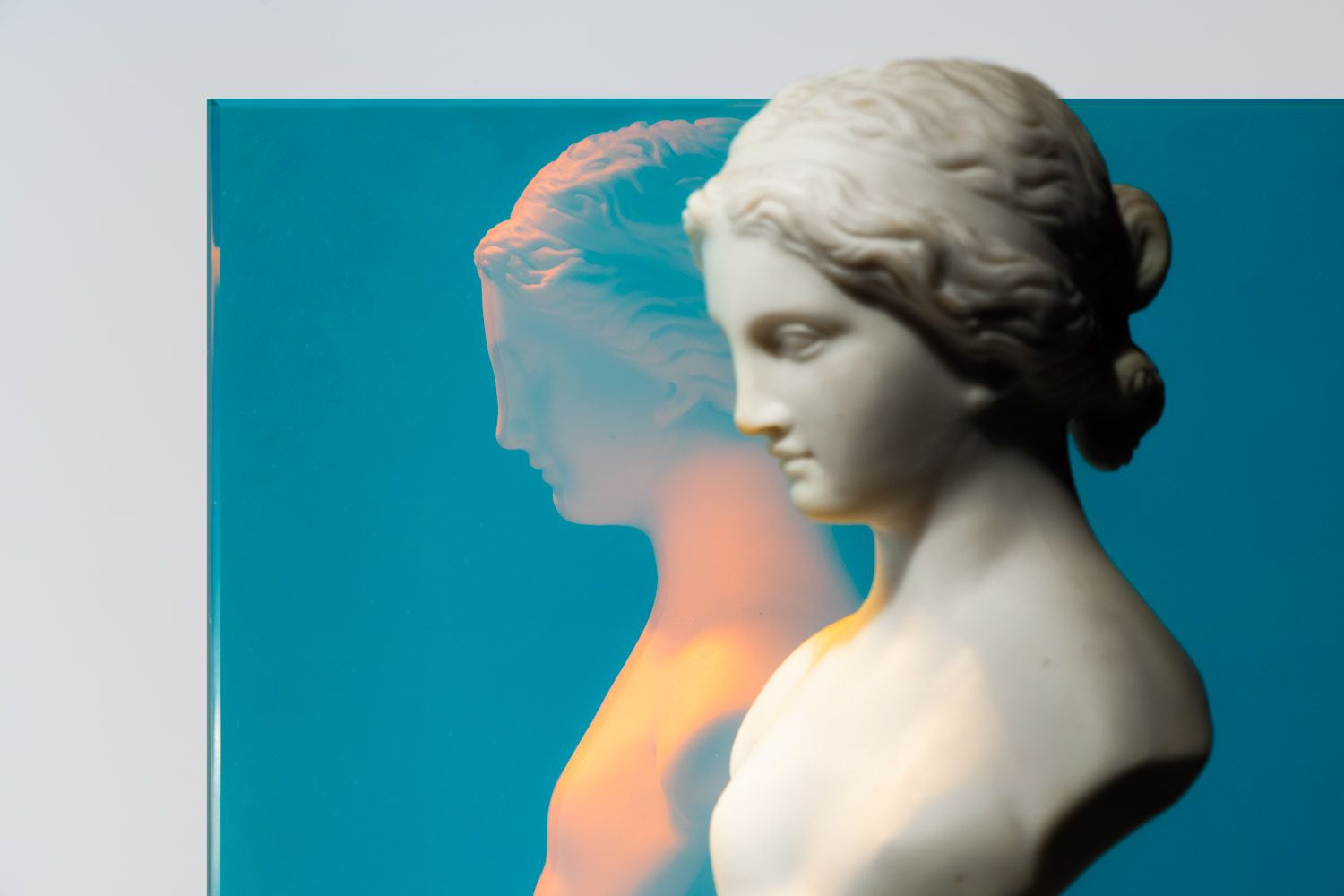
How Roman glassmakers pulled it off
The recipe was suspended metal. The glass contains minute traces of gold and silver, ground so fine that the particles interact with light itself rather than simply tinting the material. Whether the makers understood what they'd done, or stumbled onto a contaminated batch and had the sense to keep going, is still debated.
A mystery solved 16 centuries later
The cup's secret held until researchers examined fragments under electron microscopy in the late 20th century. The color shift comes from gold-silver nanoparticles dispersed through the glass — particles measured in billionths of a meter. Roman craftsmen were, in effect, doing nanotechnology by hand and by instinct.
🏛️ Museum Note: The Lycurgus Cup depicts King Lycurgus being strangled by vines — a scene from Greek myth. Some historians think the red-to-green shift was chosen deliberately to echo the story's themes of blood and transformation. The material may have been picked for its meaning, not just its beauty.
A Rare Revival in Renaissance Venice
Dichroic glass surfaced again in Renaissance Venice, the glassmaking capital of the world. Murano's artisans guarded their formulas like state secrets, and a small number of color-shifting pieces emerged from their furnaces.
These works are scarce today. The technique never scaled, likely because the results were unpredictable and the materials costly. For a few centuries after Venice, the effect went quiet. The world had the ambition but not yet the machinery.
The Space Race Reinvents Dichroic Glass
The modern history of dichroic glass starts not in a studio but in an aerospace program. In the 1950s and 60s, NASA and its contractors needed optics that could manage the brutal, unfiltered sunlight of space. Standard tinting wasn't precise enough.
The answer was thin-film coating: vaporizing metal oxides in a vacuum chamber and condensing them onto glass in layers thousands of times thinner than a human hair. The coated glass — nicknamed chameleon glass — could reflect specific wavelengths while passing others, shielding astronauts from glare and radiation.
It was engineering, pure and simple. Nobody involved was trying to make something beautiful. They did anyway.
From Lab to Studio: Artists Claim the Material
Beauty that vivid doesn't stay classified for long. By the early 1970s, an aerospace engineer who had spent the 1960s working for a NASA contractor left the industry entirely to make art with the material he'd helped refine — stained glass, sculpture, mobiles, all built around that impossible color shift.
Other artists followed, and demand pulled manufacturers in behind them. Through the 80s and 90s, dichroic glass became a fixture in studio glass, jewelry, and installation art. A coating designed for orbit was now hanging in galleries.
Dichroic Glass in Architecture Today
Architecture adopted the material last, and arguably best. At building scale, the color shift becomes kinetic: a facade that reads differently at 9 a.m. and 5 p.m., an interior wall that changes as visitors move through the space. Amazon's Doppler tower in Seattle wears dichroic glass on its facade, and the material now shows up in feature walls, countertops, partitions, and modern dichroic glass applications across hospitality, retail, and residential design.
What we always tell designers is this: don't judge dichroic glass from a photo. A photo freezes it. Order a sample, hold it near a window at midday, then again at dusk. The material you're specifying is the change itself.
Few teams in architectural glass match TCG Glass's approach to true coated dichroic glass panels — produced in-house rather than film-laminated — and it shows in work for clients like Google, Tesla, and the Ritz-Carlton. If you're newer to the material, start with what dichroic glass is and how it behaves before you spec it.
📐 Designer's Shortcut: Before committing to a large dichroic installation, view samples under the actual lighting conditions of the space — LED temperature, natural light direction, even nearby wall colors change what the glass does. Ten minutes with a sample in the real room prevents expensive surprises.
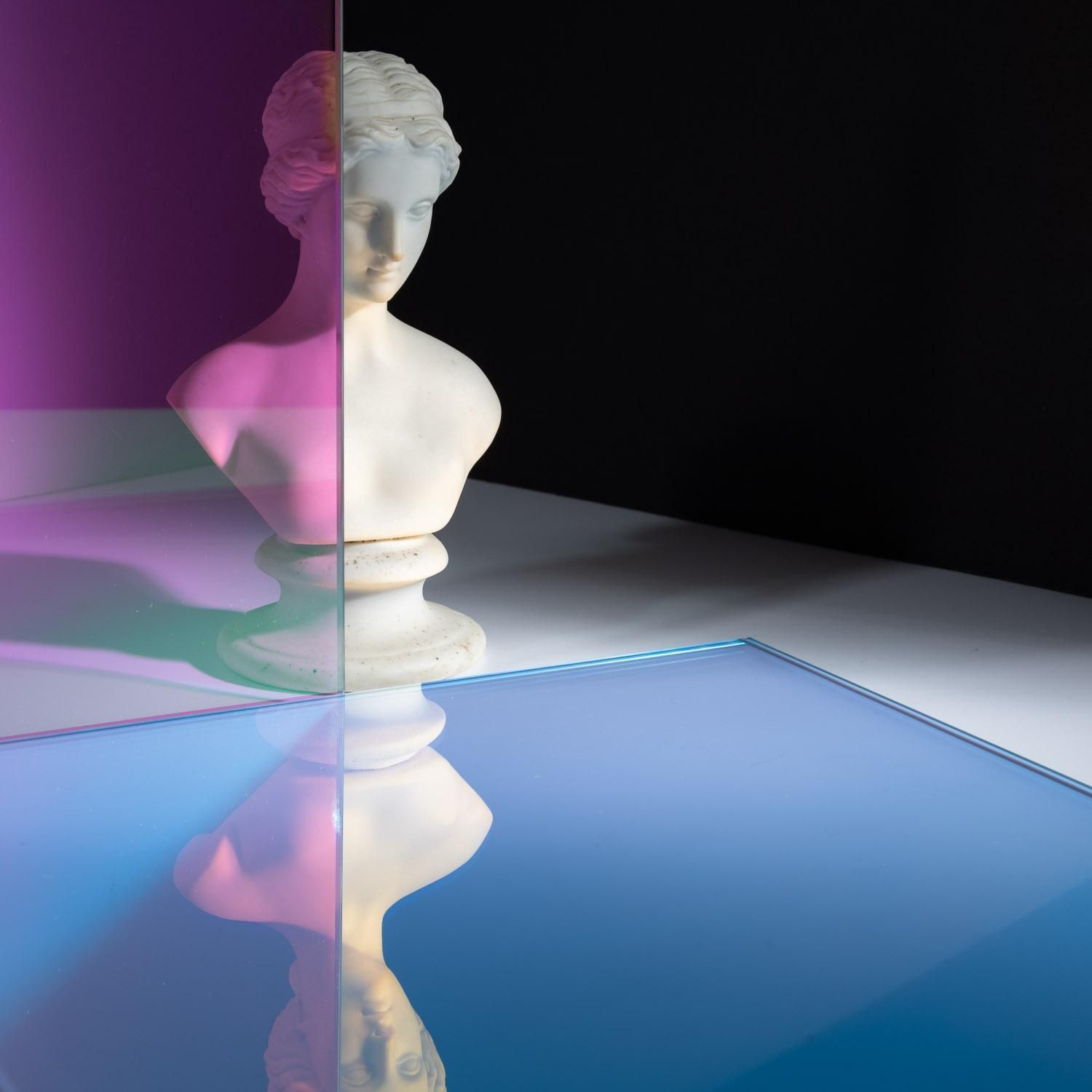
History in a New Light
Rome gave dichroic glass its mystery, Venice its craft, and NASA its precision. Today's designers get all three in a single panel. If your next project could use a material with 1,600 years of backstory and a color palette that never sits still, reach out to TCG Glass for a quote or a sample.